


Research / Mental Work · Case file
Does omega 3 change your HRV? What the studies and your ring measure
By Alejandro del Palacio · · 6 min read
The short answer
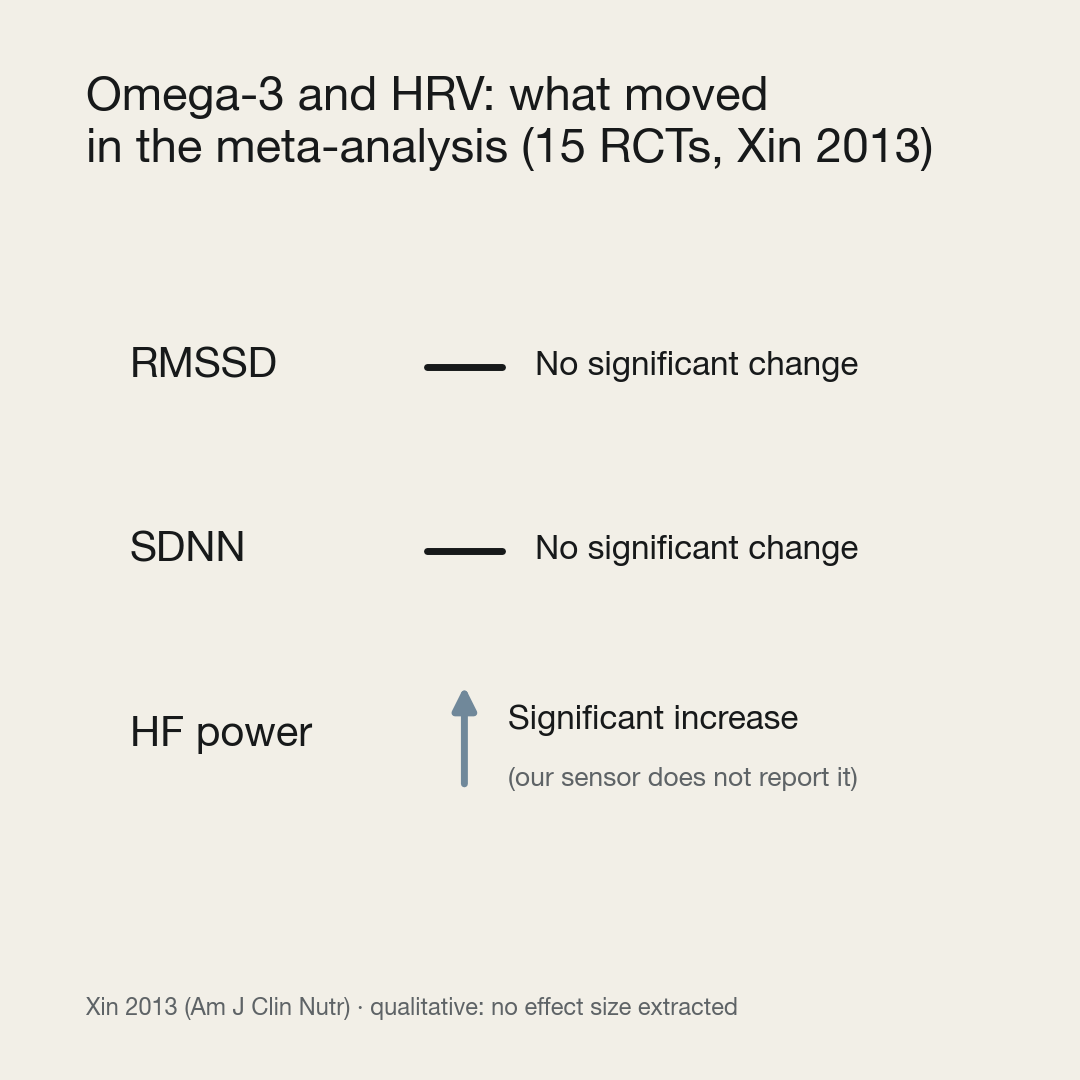
In a meta-analysis of 15 randomized controlled trials (Xin 2013), omega 3 did not significantly change RMSSD or SDNN. It did raise HF power, which our sensor does not report. In our one-body measurement (650 nights), a change in overnight HRV has to exceed a noise threshold of 11.85% in the shortest window.
- Nights measured
- 650
- Median overnight HRV
- 89 ms
- Status
- Measured
Key findings
- Meta-analysis of 15 trials (Xin 2013): omega 3 as fish oil, in humans, at variable doses and over the short term, does not significantly change RMSSD or SDNN. We do not assume that result transfers to a particular healthy person. (Xin 2013, American Journal of Clinical Nutrition)
- HF power does increase significantly. But it is a frequency marker that our sensor does not report. (Xin 2013)
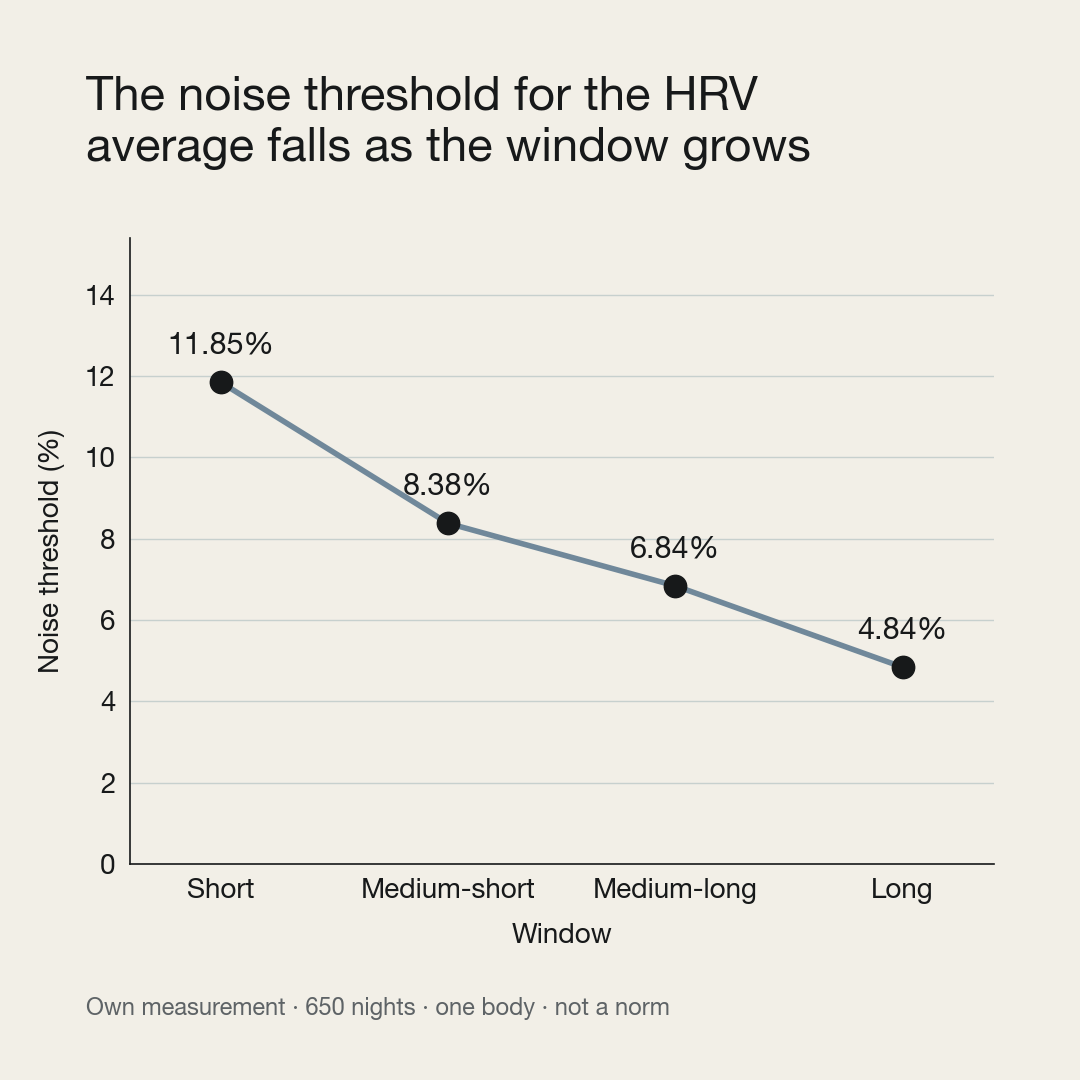
- In our measurement, the noise threshold is 11.85% in the shortest window (650 nights, one body). In this series, a smaller change cannot be told apart from noise. (own measurement)
The myth: “Omega 3 raises your HRV”
Short answer: the meta-analysis reviewed here does not show it. Across 15 randomized controlled trials, omega 3 did not significantly change RMSSD or SDNN; what rose was HF power, which our sensor does not report (Xin 2013). That result does not say what will happen in your case.
In figures
650
Nights measured
Measured89
Median overnight HRV
Measured14.94
Coefficient of variation
Measured11.85
Threshold, short window
MeasuredWhat did the omega 3 meta-analysis find about HRV?
It found that RMSSD and SDNN do not change significantly, and that HF power does increase. That is the result of Xin 2013, which pooled 15 randomized controlled trials (American Journal of Clinical Nutrition).
The evidence we use is omega 3 as fish oil, in humans, at variable doses and over the short term. The result describes that set of studies, not another form or another time frame.
SDNN and RMSSD are time-domain measures. High-frequency (HF) power is a vagal marker in the frequency domain.
We did not extract the size of the HF increase, so we do not quote it. We also could not confirm the DOI of the paper, so the source does not cite one.
Why does our sensor not see that change in HF?
Because our sensor does not report HF power. We assume its HRV is RMSSD or derived from it, but we have not verified that.
If the vagal effect of omega 3 were real, it would sit outside our instrument. And in RMSSD, the metric we assume our HRV corresponds to, the meta-analysis found no significant change.
Our sensor cannot confirm or rule out a change in HF. What we can check is whether the overnight series moved more than its noise threshold.
How much does your HRV have to move to not be noise?
It has to move more than the noise threshold of the series. In our measurement, from one body, it was 11.85% for the shortest window. That value belongs to our series, not yours.
We measured 650 nights from one body. Average overnight HRV had a median of 89 ms. The coefficient of variation was 14.94%. That coefficient measures how widely all the nights spread around their typical value; it is not the average change from one night to the next.
The 11.85% is not the only threshold in the series. Each window has its own, and longer ones lower it. It falls from 11.85% to 8.38%, then to 6.84%, and to 4.84% in the longest window.
| Measure | Value | Status |
|---|---|---|
| Nights measured | 650 | Measured |
| Median overnight HRV (ms) | 89 | Measured |
| Coefficient of variation (%) | 14.94 | Measured |
| Threshold, short window (%) | 11.85 | Measured |
| Threshold, medium-short window (%) | 8.38 | Measured |
| Threshold, medium-long window (%) | 6.84 | Measured |
| Threshold, long window (%) | 4.84 | Measured |
Source: own measurement, one body, ruido.medido.json#hrv_avg_ms.
What can you measure with your ring if you take omega 3?
What we document is one series of our own compared with the threshold of that same series. Not with someone else's, and not with a figure from a study. It is one body, so it does not document whether your ring behaves the same way.
This is not a recommendation to take anything. It is a way to read a series if you have already decided to take it on your own.
If a change in a series does not exceed its threshold, it cannot be told apart from noise. That does not prove there is nothing there. It only says this instrument does not see it. Exceeding the threshold would not say the change came from omega 3 either. It would only say the series moved more than its own noise.
Related reading:
Where the evidence ends
There are things this data does not say.
- It does not summarize other trials. This page summarizes that meta-analysis; it does not review other work on omega 3 and HRV.
- It does not say that omega 3 does nothing. It says that, when 15 trials are pooled (Xin 2013), RMSSD and SDNN do not change significantly, while HF does change.
- It does not quantify the HF increase. The size was not extracted from the study, so we write no figure.
- It does not say it applies to one specific person. The meta-analysis pools variable doses and short periods. We give no dose here.
- The threshold comes from one body. It comes from 650 measured nights. It is not a universal threshold.
- It does not state how many nights each window holds. "Short", "medium-short", "medium-long" and "long" are our own labels, and they only order the windows from smallest to largest.
- It does not say what would happen with another device, or with a direct HF measurement. It draws no health conclusion either.
What it means
The effect the meta-analysis reports is in HF power, and our sensor does not report it. RMSSD and SDNN did not change significantly, and we assume, without having verified it, that the HRV from our wearable is RMSSD or derived from it. A change in the overnight series has to beat the noise threshold of that series. In our measurement, from one body, it was 11.85% in the shortest window and falls as the window grows.
Measurement tool, not medical advice.
Quick questions
What did the omega 3 meta-analysis find about HRV?
It found that RMSSD and SDNN do not change significantly, and that HF power does increase. That is the result of Xin 2013, which pooled 15 randomized controlled trials (American Journal of Clinical Nutrition). The evidence we use is omega 3 as fish oil, in humans, at variable doses and over the short term.
Why does our sensor not see that change in HF?
Because our sensor does not report HF power. We assume its HRV is RMSSD or derived from it, but we have not verified that. If the vagal effect of omega 3 were real, it would sit outside our instrument. And in RMSSD, the metric we assume our HRV corresponds to, the meta-analysis found no significant change.
How much does your HRV have to move to not be noise?
It has to move more than the noise threshold of the series. In our measurement, from one body, it was 11.85% for the shortest window. That value belongs to our series, not yours. We measured 650 nights from one body. Average overnight HRV had a median of 89 ms. The coefficient of variation was 14.94%.
What can you measure with your ring if you take omega 3?
What we document is one series of our own compared with the threshold of that same series. Not with someone else's, and not with a figure from a study. It is one body, so it does not document whether your ring behaves the same way. This is not a recommendation to take anything.
Sources
- Xin 2013, American Journal of Clinical Nutrition, meta-analysis of 15 randomized controlled trials, on PubMed (DOI not confirmed).
- Own measurement:
ruido.medido.json#hrv_avg_ms, 650 nights, one body.
Alejandro del PalacioAuthor · reviewed 2026-11-09
pieza_id p1-omega-3-hrv-what-moves